



 (t)
which is related to the cart position X(t) by the equation:
(t)
which is related to the cart position X(t) by the equation:
 or
or
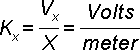
 is
is
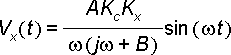 (t)
is
(t)
is
|
| |
| ||
| ||
|
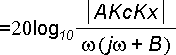
 This is a horizontal line on the Bode plot. Second, there is a pole at the
origin with a gain of
This is a horizontal line on the Bode plot. Second, there is a pole at the
origin with a gain of
 This is a line with slope of -20 DB/decade with a value of 0 DB at
 = 1 rad/sec. Third, there is a pole on the real axis at -B given by the
term
= 1 rad/sec. Third, there is a pole on the real axis at -B given by the
term
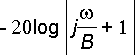 The magnitude of this at low frequencies is:
 |
( ) ) | ||
| and at high frequencies the magnitude is: | |||
 |
() | ||
 |
PREV | NEXT |  |
|
index |