Determination of Parameters for the cart and motor
Now take the Laplace Transform of both sides of the characteristic equation on the
previous page and rearrange to get the transfer function for the cart and motor.
The transfer function for the cart and motor is:
 or
or

We shall experimentally determine the unknown parameters
 and B. The standard method for doing this is to input sinusoids of various frequencies
into the system and make a Bode plot of the resulting output. We expect the Bode plot
to have a breakpoint at the frequency corresponding to the unknown parameter B. The
equations which predict this response are derived below.
and B. The standard method for doing this is to input sinusoids of various frequencies
into the system and make a Bode plot of the resulting output. We expect the Bode plot
to have a breakpoint at the frequency corresponding to the unknown parameter B. The
equations which predict this response are derived below.
Let

Here A is the amplitude of the sine wave we are inputting to the system and
 is the frequency in radians of the oscillations.
Taking the Laplace transform of both sides gives:
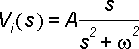
Applying this as the input to the transfer function gives:
Expanding by partial fractions:

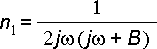


Thus:

Taking the inverse Laplace transform gives:
The last term dies away as times increases, so we are left with a steady
state solution of:
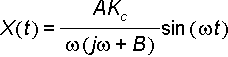
Homework: Repeat the above derivation for an input of
 Explain the differences in the results.




