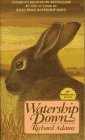
 Watership Down by Richard Adams (1972)
 The Full Facts book of Cold Reading
 Make Every Man Want You: How to Be So Irresistible You'll Barely Keep from Dating Yourself! by Marie Forleo (2008)
|
"Make Every Man Want You is so much more than a relationship book—it's an essential guide to living."
—last Acclaim For, opposite title page "I've whipped up an intriguing title to trick you into reading this book." —page xx Your Thoughts About Men Affect the Way They Behave Toward You If you believe your thoughts reside exclusively in the privacy of your mind, think again. Your thoughts are palpable and resonate with others. Whether you like it or not, you have an impact on how people behave around you. Your ideas, thoughts, and beliefs about people influence how they treat you. Perception is an act of creation. People have evolved an uncanny ability to read other people, and most of it is unconscious. |
 THE PRISONER — Series starring Patrick McGoohan as
"number 6" episode 6, "The General" (1967).
THE PRISONER — Series starring Patrick McGoohan as
"number 6" episode 6, "The General" (1967).
|
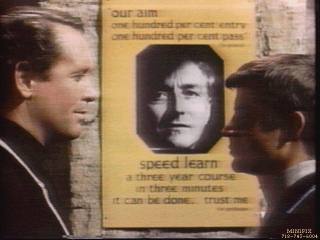
What would happen if a computer could just beam all the facts into your brain—
would that make you educated?
 The Prisoner - Complete Collection
Or just buy the 2nd DVD which has the episode "The General"  The Prisoner - Set 2: Checkmate/ The Chimes of Big Ben/ A, B and C/ The General (Bonus)
|


| "Now, ask the Computer---" "A question that can't be answered." "What's that?" "There is a question that the Computer can not answer." "Impossible." "Allow me to ask it." Number 6 presses four keys on the keyboard. Dials immediately move to their "Danger" zones. The computer starts to roar and spark. Smoke pours out of the Computer's ventilation grilles, followed by a massive explosion. The Computer, which could teach you everything by just beaming all the answers into your brain, is destroyed. "What was the question?" "It's insoluble, for man or machine. — W. H. Y. Question mark." "Why?" "Why..." (Transcript of entire episode) (Brief Synopsis of episode) (Commentary on episode) |

 DUCKMAN — Episode 3 "The Gripes of Wrath" (1994).
|
What would happen if a computer solved all the world's problems and made the world perfect?
In this episode a supercomputer named Loreta does just that — with disastrous results.
(1/2 hour. Note this show is rated TV-MA for mature audiences due to language content.) Ask me for a copy of the episode. | |


|
"You were the one who made up this whole new world!
You screwed up — not me!" "Impossible! I am infallible!" "I don't care what religion you are. You made things worse when you made them better! I mean, I liked having a lot of free time, but I hated not having anything to do. Don't you see, things were good when they were bad, and they got bad when they were good. People aren't happy unless they're unhappy." {The computer catches fire and blows up.} "I believe you presented Loreta with one of the quintessential paradoxes of the modern era. The idea that the most perfect world is an imperfect world, because imperfection creates the drive in people to make things better. The irony being that maybe the most perfect parent is actually an imperfect parent." |
 Cold Turkey (1971)
 Einstein for Beginners
by Joseph Schwartz, Michael McGuinness (Contributor) (1979).
Einstein for Beginners
by Joseph Schwartz, Michael McGuinness (Contributor) (1979). Introduction to Special Relativity by T. M. Helliwell (1972)
is an excellent book for people who know calculus. I found it easy
to read and understand, unlike most books on the subject.
See if you can find the book in a university library.
T. M. Helliwell is a professor at Harvey Mudd college.
The book is available from the Harvey Mudd college bookstore.
Contact the Harvey Mudd college bookstore and ask for a copy.
Or contact Prof. T. M. Helliwell at
http://www.physics.hmc.edu/faculty/helliwell/
Introduction to Special Relativity by T. M. Helliwell (1972)
is an excellent book for people who know calculus. I found it easy
to read and understand, unlike most books on the subject.
See if you can find the book in a university library.
T. M. Helliwell is a professor at Harvey Mudd college.
The book is available from the Harvey Mudd college bookstore.
Contact the Harvey Mudd college bookstore and ask for a copy.
Or contact Prof. T. M. Helliwell at
http://www.physics.hmc.edu/faculty/helliwell/
 How to Lie With Statistics
by Darrell Huff, Irving Geis (Illustrator) (1954)
How to Lie With Statistics
by Darrell Huff, Irving Geis (Illustrator) (1954) Flatland
by Edwin A. Abbott (1884)
Flatland
by Edwin A. Abbott (1884) Four Colors Suffice: How the Map Problem Was Solved
by Robin Wilson (2002)
Four Colors Suffice: How the Map Problem Was Solved
by Robin Wilson (2002) Gödel's Proof
by Ernest Nagel, James Roy Newman (1958). Forward by Douglas R. Hofstadter.
Gödel's Proof
by Ernest Nagel, James Roy Newman (1958). Forward by Douglas R. Hofstadter. GÖDEL, ESCHER, BACH: an Eternal Golden Braid
by Douglas R. Hofstadter (1979)
GÖDEL, ESCHER, BACH: an Eternal Golden Braid
by Douglas R. Hofstadter (1979) FERMAT'S ENIGMA: The Epic Quest to Solve the World's Greatest Mathematical Problem
by Simon Singh (1997)
FERMAT'S ENIGMA: The Epic Quest to Solve the World's Greatest Mathematical Problem
by Simon Singh (1997) Extraordinary Popular Delusions & the Madness of Crowds
by Charles MacKay (1841)
Extraordinary Popular Delusions & the Madness of Crowds
by Charles MacKay (1841) Eccentric Lives and Peculiar Notions
by John Michell (1984)
Eccentric Lives and Peculiar Notions
by John Michell (1984) The Affairs of Dame Rumor
by David J. Jacobson (1948)
The Affairs of Dame Rumor
by David J. Jacobson (1948)
|
In history there are no absolutes. When it comes to controversial issues,
the historian deals with probabilities, not finalities.
(Quoted from the book
 Not So! Popular Myths About America from Columbus to Clinton.
by Paul F. Boller, Jr.
 Lies My Teacher Told Me: Everything Your American History Textbook Got Wrong
by James W. Loewen
Read the Preface to the book [this site]
 Einstein's Luck: The Truth Behind Some of the Greatest Scientific Discoveries
by John Waller.
Year: 2002.
Even the history of science has been mythologized. (I've no idea why the book is
titled Einstein's Luck. Einstein isn't one of the science heros explored.
Author Eddington is explored. He allegedly proved correct Einstein's General Theory of
Relativity by careful examination of a solar eclipse in 1919. However the data was
actually inconclusive. It was a strong belief that Einstein was correct which led to
the unsubstantiated conclusion.)
History Books by Howard Zinn


 MORAL POLITICS: How Liberals and Conservatives Think
by George Lakoff.
Year: 1996 (2nd edition 2002). “Contemporary American Politics is about worldview. Conservatives
simply see the world differently than do progressives, and both often have a difficult time
understanding accurately what the other’s worldview is.” Lakoff explains
that Conservatives and Progressives have two very different concepts of Morality. This is
an excellent book for anyone wanting to understand the other side's point of view.
See a lecture given by George Lakoff at
http://www.uctv.tv/search-details.aspx?showID=11194
Also see
RED vs. BLUE:
The Difference Between the Conservative and Progressive Thought Process
MORAL POLITICS: How Liberals and Conservatives Think
by George Lakoff.
Year: 1996 (2nd edition 2002). “Contemporary American Politics is about worldview. Conservatives
simply see the world differently than do progressives, and both often have a difficult time
understanding accurately what the other’s worldview is.” Lakoff explains
that Conservatives and Progressives have two very different concepts of Morality. This is
an excellent book for anyone wanting to understand the other side's point of view.
See a lecture given by George Lakoff at
http://www.uctv.tv/search-details.aspx?showID=11194
Also see
RED vs. BLUE:
The Difference Between the Conservative and Progressive Thought Process
 Please Understand Me II: Temperament, Character, Intelligence
by David Keirsey.
Year: 1998.
A classic book on the 16 different personality types identified by Myers-Briggs.
Myers-Briggs divides personality types into four major categories, with each category
having four subcategories, for a total of 16 different personality types. Understanding
that other people actually think in different ways from you is initially a hard concept
to learn, but eventually you'll understand why most other people seem to be different
from you—it's because they are. Again, there is no "right" personality type, there
are just different personalities. Also see www.keirsey.com
Please Understand Me II: Temperament, Character, Intelligence
by David Keirsey.
Year: 1998.
A classic book on the 16 different personality types identified by Myers-Briggs.
Myers-Briggs divides personality types into four major categories, with each category
having four subcategories, for a total of 16 different personality types. Understanding
that other people actually think in different ways from you is initially a hard concept
to learn, but eventually you'll understand why most other people seem to be different
from you—it's because they are. Again, there is no "right" personality type, there
are just different personalities. Also see www.keirsey.com
I believe there is a connection between conservative thought and the SJ 'Guardian' personality type described in this book. Not that all Guardians are conservative, but quite possibly all conservatives are Guardians who don't understand there are other personality types. Conservatives classifly all these other people as immoral.
Update: I now believe the difference is determined by how much people meditate. People who meditate often are more compassionate, and compassion is at the root of Democratic values. (July, 2015)
 Presidential Temperament: The Unfolding of Character in the Forty Presidents of the United States
by Ray Choiniere, David Keirsey.
Year: 1992.
A good companion to
Please Understand Me II.
Gives real life examples of the various character and temperament types.
Presidential Temperament: The Unfolding of Character in the Forty Presidents of the United States
by Ray Choiniere, David Keirsey.
Year: 1992.
A good companion to
Please Understand Me II.
Gives real life examples of the various character and temperament types.
 MORE BOOKS RELATED TO THIS ISSUE OF RED vs. BLUE
 |
Back to Miscellaneous Topics |